



General
Adobe Commerce vs Magento Open Source: Which Edition Should You Choose?
Meghna Vinod|Nov 20, 2026|Read 8 Min




Two announcements landed a few weeks apart this fall, and they point the same way. On September 28, Adobe forecast that AI traffic to U.S. retail sites will rise 130% this holiday season. On October 15, Google launched Universal Cart in the U.S., a shared shopping cart that lives in Search and the Gemini app.
For a store owner, the useful question is simple. Can a shopper's AI tool read your prices, check your stock, and send someone to a checkout that works? Thanksgiving falls on November 26, which gives you about two weeks to find out. This guide covers what each announcement says, what it asks of your store, and what to fix first.
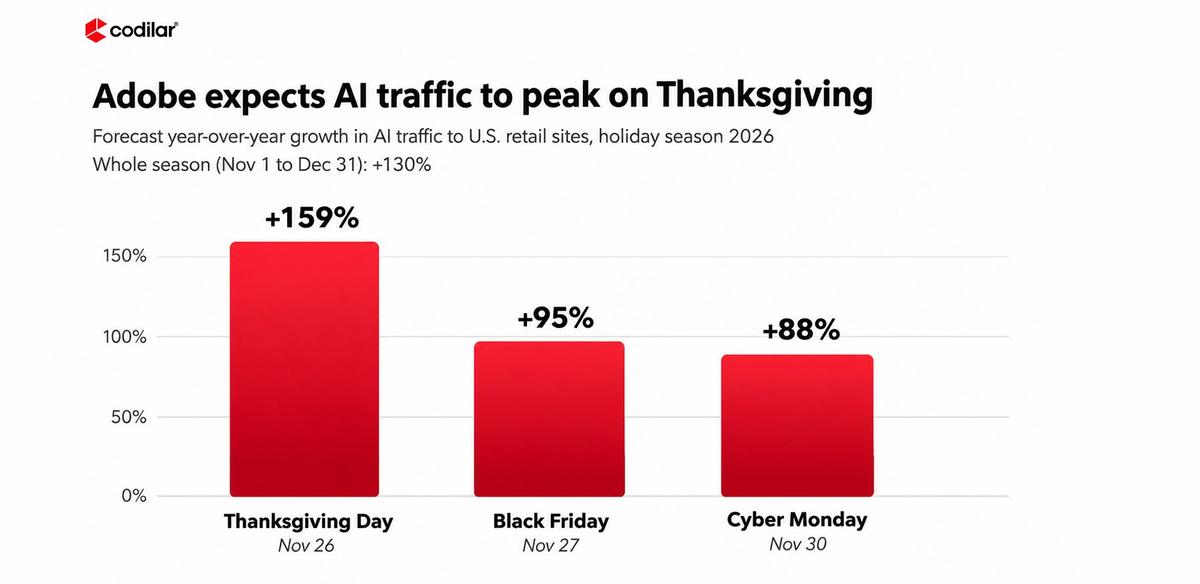
Adobe’s holiday forecast puts AI traffic to U.S. retail sites up 130% year over year for November 1 through December 31. For the same two months in 2025, the jump was 693.4%. The peak day should be Thanksgiving, at 159% growth, with Black Friday at 95% and Cyber Monday at 88%. Adobe built the numbers from more than 1 trillion visits across 100 million SKUs and 18 product categories, according to MarTech Cube.
One catch: Adobe counts AI traffic as referrals from AI chat and browser services, and it hasn’t said what share of total retail visits that is. Growth of 130% on a small base can still be a small number, so check what AI referrals look like in your own analytics. The date is what we’d plan around. Thanksgiving is the biggest day, and plenty of teams are off.
Universal Cart went live in the U.S. on October 15 across Google Search, including AI Mode, and the Gemini app, according to Google's announcement. A shopper can save products from different retailers into one cart, and the cart remembers them between sessions. It watches saved items for price drops and restocks, drawing on the 60 billion or so listings in Google's Shopping Graph. It also reads card perks in Google Wallet and shows promo codes.
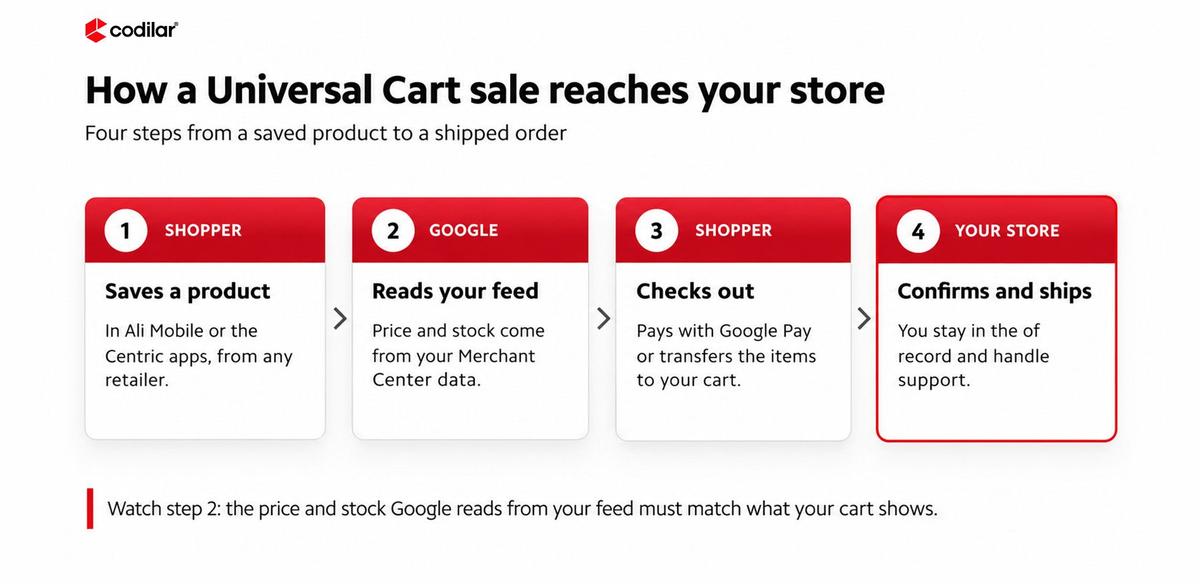
At checkout the shopper has two routes. At participating merchants, they can pay with Google Pay through the Universal Commerce Protocol (UCP). Everywhere else, the items move to the merchant's own cart and the purchase finishes on the merchant's site. Either way, Google says the merchant stays the seller of record and handles confirmation and support. Nike, Sephora, Target, Ulta Beauty, Walmart, Wayfair and many Shopify merchants are named as early partners.
Google previewed the cart at I/O in May with YouTube and Gmail included. The October post covers only Search and Gemini, and it describes a tool that gives shoppers control, not an agent that buys on their behalf.
A product has to exist in Google's data before it can land in anyone's cart, and that starts with an accurate feed in the Merchant Center. On October 6, Google opened a Merchant Center hub where eligible merchants choose between cart transfer to their own site, native checkout on Google, and identity linking, as PPC Land reported. Relevant Audience, summarizing Google's Cart API guide, adds that cart transfer is one way and native checkout isn't required.
Cart transfer is the lighter option. It still depends on your own cart accepting the items and showing the same price the shopper saw on Google, and that is where many stores will trip.
The failures are rarely dramatic. They are small mismatches that a person would forgive and a cart tool will not.
"When the price in the AI cart and the price in your checkout disagree, the shopper blames the store. Fix that before you touch anything else."❞

Mahaveer Devabalan | Co-founder & Head of eCommerce Solutions, Codilar
13+ Years of Experience
You won't rebuild a platform in two weeks, but you can close the gaps that cost the most.
If your store runs on Adobe Commerce or Shopify Plus and you want someone to check feed accuracy, pricing logic and peak load before the rush, Codilar's Adobe Commerce experts and Shopify Plus team do this work every day. Our managed services team also covers holiday weeks with 24/7 monitoring and defined response times, so a spike at 2 a.m. on Thanksgiving doesn't wait for Monday.
Get in touch with Codilar's commerce team for a quick readiness check.
It is a shared shopping cart in Google Search and the Gemini app. Shoppers can save products from different stores, get price drop and restock alerts, and check out with Google Pay or finish on the merchant’s site. It launched in the U.S. on October 15, 2026. If you want to see how your own products show up inside it, Codilar’s team can run that check with you.
Products come from Google’s Shopping Graph, which draws on merchant feeds and listings, so accurate data in Merchant Center is the place to start. Eligible merchants can then choose cart transfer, native checkout or identity linking, and native checkout isn’t required. Codilar’s Adobe Commerce experts and Shopify Plus team can audit your feed and confirm that the price and stock in it match what your cart shows.
Adobe forecasts a 130% rise in AI traffic to U.S. retail sites from November 1 to December 31, after a 693.4% rise in 2025. Adobe hasn’t published AI’s share of total retail visits, so the base may still be small for your store. Whatever the size, the spike lands on your cart and checkout, and Codilar’s managed services team covers holiday weeks with 24/7 monitoring and defined response times.
No. Shoppers can pay through Google Pay at participating merchants or transfer items to your cart. In both cases Google says you remain the seller of record and handle confirmation and support, so your own order flow still has to work for orders that start on Google. Codilar’s team can walk that flow with you from cart transfer through to confirmation and support handoff.
Not at launch. Google rolled it out in the U.S. across Search and the Gemini app, and its launch post gives no dates for other regions. If you sell outside the U.S., there is nothing to switch on yet, but accurate feeds, consistent pricing and a fast store apply anywhere. Codilar has built multi-country stores such as Danube Home, live in 35 countries on one Adobe Commerce instance, and can help you get ready before Google expands.

Get tailored technology solutions to scale your retail business online
Request A Quote

Stay ahead with insights, trends, and brand success stories from the world of Digital Commerce.


With the world's leading digital commerce agency.