



General
How Google's November 2026 Core Update and Gemini 4 Hydrogen Affect eCommerce SEO
Meghna Vinod|Nov 18, 2026|Read 7 Min




Here's a quick test before we start. Which of these sounds most like you?
"We have a great dev team and a tight budget."
"My business buyers want quotes, approvals and their own prices."
"We're opening in new countries next year."
"I'd happily never think about security patches again."
Each one points to a different answer, and that's exactly why a simple "which is better" never works for Adobe Commerce and Magento Open Source. They share the same core codebase, so whichever you pick, you're building on the same foundation. What changes is the cost, the B2B features, the hosting and security setup, and how much work it takes to keep the store healthy.
So this guide helps you find your own answer. We'll compare the two editions side by side, look at what each costs over time, see which suits B2B and growth, and cover hosting, security and upgrades. You'll also meet the stores we've worked on, including TGR, Lals Group, Marina Home and Kanmo Group. We work on both editions every day at Codilar, so we have no reason to push you either way.
The quick answer if you're in a hurry. Magento Open Source is free to download and gives you full control, but you pay for hosting, developers, security and support yourself. Adobe Commerce adds a paid license, built in B2B tools, Adobe support and hosting options. Choose Open Source if you have a strong tech team and a simpler store. Choose Adobe Commerce if you sell B2B, run several brands or countries, or want Adobe to carry more of the load.
Think of Magento Open Source as buying the land and building the house yourself. You get freedom, and you also get the maintenance. Adobe Commerce is the same house with a service contract and more rooms already built.
Technically, Open Source is the free, community supported edition. Adobe Commerce is the paid edition, and it's what used to be called Magento Commerce. Here's the quick view.
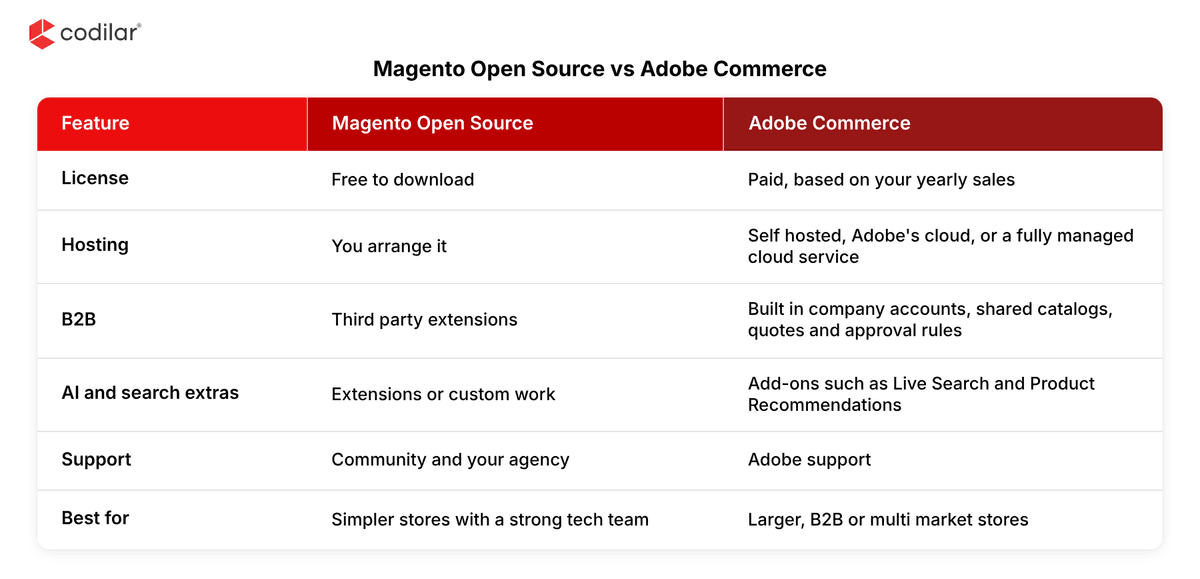
If you only remember one line, make it this one. Open Source is a platform you run yourself. Adobe Commerce is a platform you run with more built in and more backup.
Let's start with the part everyone wants to know. Open Source costs nothing to download. But a store doesn't run on a download, so you still pay for hosting, developers, security patches, PCI compliance work, extensions and monitoring.
Adobe Commerce is priced on the yearly sales you declare, and Adobe doesn't publish a price list. You'll get a quote, and it depends on the deployment, the term and any add-ons you pick. We won't print a number here, since it would be out of date quickly.
Instead of comparing sticker prices, compare what you'd spend over three to five years. Count the license, hosting, developer time, the extensions you'd otherwise need for features that come built in, and the cost of downtime. A store that needs B2B tools can end up spending more on extensions and custom work with Open Source than the license would have cost. A simple store with a strong in house team often comes out cheaper on Open Source. So we always ask about your team before we ask about your budget.
For B2B, Adobe Commerce wins in most cases. It comes with company accounts and hierarchies, shared catalogs with company specific prices, negotiable quotes, requisition lists, and purchase order approval rules. Open Source has none of that built in. You'd add a third party B2B suite and patch it alongside the core.
Two examples from our own projects. TGR, a global wholesale supplier, was running several separate Magento instances. We merged them into one Adobe Commerce platform that serves both B2B and B2C, with 10 websites, 150+ customer groups and a 60GB+ database. The result was a 40% improvement in website performance, and the project won a B2B Champ Award at Meet Magento India 2024.
For Lals Group, a retail group with more than 70 stores across the GCC, we built on Adobe Commerce with Pimcore managing 85,000+ SKUs. A regional storefront with 12,000+ SKUs went live in 14 days, and filter pages loaded 77% faster. You can also hear JPW, which runs five Adobe Commerce stores, talk about working with us.
Here's something people are often surprised by. Speed depends far more on how your store is built and hosted than on which edition you run. We've seen it on both sides.
Marina Home, a Dubai home fashion brand, moved to a multi node AWS setup with better caching and a CDN. They report 35 to 45% faster page loads and an 85+ Lighthouse score. For Veppy, a UAE marketplace, we moved a single server to a six node, multi zone AWS setup, with 24x7 monitoring and a zero downtime cutover. Server response time roughly doubled in speed.
What the edition changes is who carries the responsibility. With Open Source, you or your agency arrange hosting, apply security patches and handle compliance such as PCI. Adobe Commerce can run on Adobe's cloud infrastructure, which includes the Fastly CDN and a web application firewall, and Adobe also ships security patches you can apply on their own, without a full upgrade. There's even a fully managed Adobe Commerce as a Cloud Service, where Adobe applies the patches for you. Either way, patch quickly. Old, unpatched Magento stores are an easy target.
Honestly, neither one is hands off. Both need regular upgrades, and the work is real. Version 2.4.9, released in May 2026, moved the supported stack to PHP 8.5 and OpenSearch 3, among other changes, so one upgrade can touch your server, your extensions and your custom code.
Older versions also stop getting fixes, so staying current matters on both editions. For Kanmo Group, an Indonesian retail group, we upgraded their Magento 2 stores from 2.3.x to 2.4.5 and removed over half of their redundant modules. They saw 30% faster page loads and 35% faster order fulfillment. The module cleanup made the biggest difference, and it's a good habit whichever edition you run.
If you're on Open Source and want an alternative to relying on a single vendor, there's also Mage-OS, a community driven distribution built on Magento Open Source. Its 3.0 release in May 2026 is based on Open Source 2.4.9. Check its extension compatibility and support before you choose it.
Whichever edition you land on, two problems tend to show up sooner or later. Category pages get slow, and customer data sits in the database in plain text. We built a tool for each.
PowerListing is for slow product listing pages. Instead of leaning on heavy MySQL queries, it serves listings through OpenSearch or Elasticsearch. It works on the Magento backend only, so your theme and frontend stay exactly as they are. Codilar says stores can see up to 2 to 5 times faster listings and up to 80% lower infrastructure costs, though your own results will depend on your catalog and setup. You keep the code, with no recurring license charges, and we start with a free infrastructure audit. You'll need an existing OpenSearch or Elasticsearch cluster. You can read the details on the PowerListing page.
PII Shield is for customer data. Adobe Commerce already encrypts payment credentials and system configuration and hashes passwords, but most customer personal data is stored as plain text. PII Shield adds field level encryption across nine areas, including customers, carts, orders, invoices, shipments, credit memos, newsletter subscriptions and admin users. Data is encrypted when it's saved and decrypted for authorized users in real time, so your storefront and admin work the same as before. If someone reaches the database directly, they see unreadable text. It uses Libsodium, the same cryptographic library Adobe Commerce uses internally, and the keys stay in the application, not the database. Codilar describes the performance overhead as negligible. Check version compatibility with our team first. Our PII Shield write-up explains how it works.
Both are worth a conversation if you're running a large catalog or handling a lot of customer data, on Open Source or Adobe Commerce.
Go with Magento Open Source if you have a capable in house team or a trusted agency, you run one brand or market, B2B isn't a big part of your plan, and you want full control over cost and code.
Go with Adobe Commerce if you sell B2B, run several brands, websites or countries, want Adobe's support behind you, or would rather have Adobe handle more of the hosting and security.
And you don't have to decide forever. Because the two editions share a codebase, moving from Open Source to Adobe Commerce is usually an upgrade project and rarely a full rebuild. Plenty of stores start on Open Source and move over when B2B, new markets or support needs grow. Just plan it early and keep your custom code tidy.
If you're still unsure, we're happy to look at your store with you. We're an Adobe Gold Solution Partner and a Magento Solution Partner, with 11+ years of experience and 500+ projects delivered. Our Adobe certified team works on both editions, so we've got no reason to push one over the other. We'll look at your catalog, your B2B needs, your team, your hosting and your plans, and give you a straight view of which edition fits and what the move would take.
You can read more about our Adobe Commerce development services, or see how we compared the two earlier in our Adobe Commerce vs Magento 2 Open Source guide. Already on an older version? We can check what an upgrade would take too.
Talk to Codilar's Adobe Commerce team about the right edition for your store.
Magento Open Source is the free, community supported edition. Adobe Commerce is the paid edition with built in B2B tools, Adobe support and cloud hosting options. Codilar works on both and can recommend the right fit.
The software is free to download, but you pay for hosting, developers, security patches, extensions and monitoring. For some stores, those costs add up to more than expected. Codilar can estimate your total cost over three to five years.
Yes, in most cases. Both editions share a codebase, so it's usually an upgrade project and rarely a full rebuild. Keep your custom code tidy beforehand, and Codilar's team can plan the move with you.
Adobe Commerce, because it includes company accounts, shared catalogs, quotes and approval rules. Open Source can do B2B through third party extensions that you maintain. We built a combined B2B and B2C Adobe Commerce platform for TGR.
Yes. Both need regular upgrades and security patches, and older versions stop receiving fixes. Version 2.4.9, released in May 2026, changed the supported stack, so plan upgrades early. Codilar can check what yours would take.

Get tailored technology solutions to scale your retail business online
Request A Quote

Stay ahead with insights, trends, and brand success stories from the world of Digital Commerce.


With the world's leading digital commerce agency.