



General
How Much Does an Apparel eCommerce Website Cost in 2026?
Aakash Ashok|Nov 13, 2026|Read 6 Min




If you run your website on AEM 6.5, you've probably had the same three names thrown at you lately. AEM 6.5 LTS. AEM as a Cloud Service. Edge Delivery Services. Everyone seems to have a favorite, and most of them are selling something.
We build on AEM every week, and we've sat on both sides of this decision. So this isn't a comparison chart. It's the order we'd walk through things with you, using what Adobe has published and what we've seen on our own projects. We'll start with where AEM 6.5 stands, then look at one of our AEM and Adobe Commerce builds, and then go through the three routes and the questions that settle the choice.
Start with the facts, because there's a lot of confusion about them. Support for Managed Services customers ended by August 31, 2026. For on premise setups, core support is currently planned to end by February 2027. The last service pack is 6.5.26.0, and each service pack gets up to 18 months of support.
Extended support runs to February 2028 for customers Adobe approves, but it covers critical security fixes only, and only on that final service pack. These dates can still change, so check Adobe's roadmap page before you plan around them. Nothing breaks when the dates pass. Your site keeps running. The difference is that regular fixes stop, and the longer you wait, the more old Java and library versions pile up behind you.
We think the version question gets too much attention, so here is a project that shows why. We worked with a Southeast Asian airline brand on its online shop, as a joint project with Adobe. The goal was content management and approval workflows on AEM, sitting on top of Adobe Commerce. We built custom AEM components for the shopping experience. We modified Adobe Commerce APIs so the AEM front end could use them through GraphQL. And we connected the whole thing to product data, loyalty, order management and search.
Read that scope again and notice what's missing. Nothing in it depends on which AEM version you happen to run. The work lived in custom components and in the connections between systems. That's our view of AEM 6.5 too. The version decides what support you get. The custom code and the integrations decide how hard your move will be.
AEM 6.5 LTS is Adobe's route for staying on the 6.5 line. You upgrade in place from a supported 6.5 service pack. It runs on Java 17 or 21, and you keep your servers and most of your code. It's the fastest option, usually weeks to months.
There's a cost. Some legacy features were removed. You still patch and run the platform yourself. And the newer Cloud Service features, including Adobe's AI tools, aren't part of it. LTS is also a separate branch, so the work might not carry over if you move to Cloud Service later. Test that on your own code before you rely on it.
We'd look at LTS first if you have a lot of customization and need supported software soon.
With Cloud Service, Adobe runs the platform and updates it continuously. Your team stops managing servers and planning upgrade projects. But how you work changes. Cloud Manager is the only way to deploy, /apps and /libs are read only at runtime, and a security rating below B fails your pipeline.
Code that relies on removed APIs, mutable /apps, custom run modes, Classic UI or replication agents needs refactoring. That's why we ask about custom code before anything else. A project with heavy custom components, like the airline build above, will need a careful look at each one.
Enterprise Cloud Service migrations are often estimated at six to twelve months. Your own number comes from what the Best Practices Analyzer finds.
Edge Delivery Services is a different way to build the site, so it asks for the most change. It adds an Adobe managed CDN, GitHub based deployment and a rebuilt front end, and authors can work in documents or the Universal Editor.
It works best on marketing sites where page speed matters more than reusing your existing components. It can run next to AEM Sites, so many teams adopt it one section at a time. Some organizations also combine routes, for example an LTS upgrade first and staged moves to Cloud Service or Edge Delivery after that.
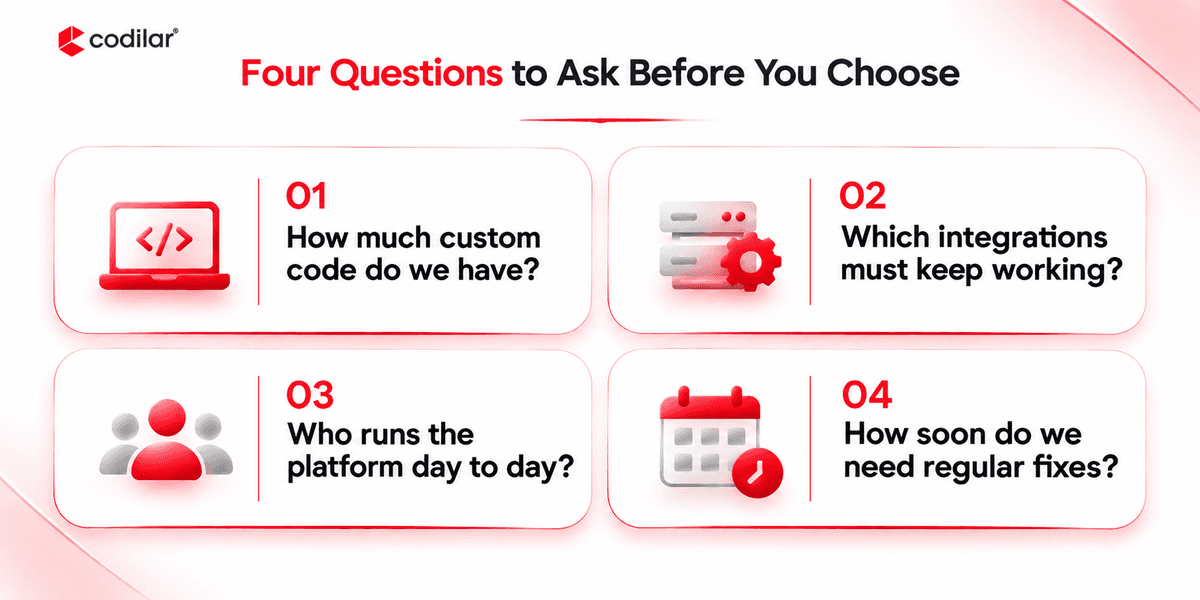
Most of the time your custom code makes the choice for you. Look at that list before you look at any vendor deck.❞

Mohammad Mujassam | VP Commerce & DX Practice
13+ Years of Experience
The quickest way to answer them is to run the Best Practices Analyzer on production and list every custom OSGi bundle and integration with an owner next to each. That list also makes any quote you receive easier to compare.
AEM is a core part of what we do. Our Adobe certified team covers AEM website development, content management and approval workflows, custom AEM solutions, migrations and upgrades, integrations with enterprise tools and 24/7 support. We're part of a 300+ strong team with offices in the USA, Australia, Singapore, KSA, UAE, Oman, Indonesia and India.
Our work sits where content and commerce meet. For Ooka, a hookah brand, we added a headless AEM front end to an Adobe Commerce store with a multilingual site, as described in our write up of the project. You can see the full case study here. Ooka was a new build, and it wasn't a version migration. You can read more about our AEM development services.
If you're on 6.5, we offer a free security check. We look at your service pack and Java level, how exposed your instance is, and which custom code and integrations would affect each route. You get a short written summary to share with your team or with Adobe. If you're on Managed Services, it's worth asking Adobe what you're covered for now, since those customers are already past their support date.
Every AEM 6.5 site has a list of custom components and integrations, whether anyone wrote it down or not. That list is what decided the shape of our airline project, and it will decide yours. Once it exists, the choice between LTS, Cloud Service and Edge Delivery gets a lot clearer.
Codilar's AEM team can go through that list with you, and our free security check is an easy first step. Request a free AEM security check and decide with the full picture in front of you.
Managed Services support ended by August 31, 2026, and on premise core support is planned to end by February 2027. With Adobe's approval, extended support runs to February 2028 for critical security fixes only. We can help you check what your contract covers.
LTS is quicker and keeps your infrastructure. With Cloud Service, Adobe runs the platform, and some custom code may need rewriting. Many teams do LTS first and Cloud Service later. Our AEM team can map your custom code against both.
An LTS upgrade usually takes weeks to months, and enterprise Cloud Service moves are often estimated at six to twelve months. Your timeline depends on custom code and integrations. Our free security check gives you a first read.
Not exactly. It's another way to build, suited to speed focused marketing sites, and it can run next to AEM Sites. We can help you decide which parts of your site belong where.
After February 2027, only approved extended support applies, and it covers critical security fixes on the last service pack. Our free security check shows how exposed your setup is.

Get tailored technology solutions to scale your retail business online
Request A Quote

Stay ahead with insights, trends, and brand success stories from the world of Digital Commerce.


With the world's leading digital commerce agency.