



General
PolyShell CVE-2026-48356: Secure Your Adobe Commerce & Magento Stores
Meghna Vinod|Oct 29, 2026|Read 6 Min



CVE-2026-111497 is a critical out-of-bounds write in the Brotli decoder. CISA confirmed active exploitation on October 27, 2026. Node.js, Python, Envoy, and Istio are all affected. Host-level patching is not enough; every container that carries a Brotli dependency must be rebuilt and redeployed.
On October 27, 2026, CISA added CVE-2026-111497 to its Known Exploited Vulnerabilities catalog. The vulnerability carries a CVSS score of 9.2. A public proof of concept appeared on October 22. Imperva’s Red Team demonstrated code execution on an official Node.js image, ELLIO reported exploit traffic in the wild before CISA’s confirmation, and Federal agencies have a remediation deadline of November 10, 2026.
The flaw is in Brotli, a compression library embedded across the modern web stack. Node.js is where it was discovered, and the Brotli decoder is where it lives.
Node2Shell is the name researchers assigned to CVE-2026-111497, a critical flaw in the Google Brotli C decoder. The same vulnerability appears in advisories as HTTP2Shell CVE and Broccoli2Shell, referring to the same CVE.
Brotli is a compression algorithm developed by Google and embedded inside Node.js, Python, PHP, .NET, and several other runtimes. The flaw sits inside DecodeBlockTypeAndLength(), a function that returns a plain boolean instead of a typed error code. Callers cannot distinguish a malformed Brotli stream from a request for more input. On the fast path, the return value is discarded entirely. The decoder continues writing attacker-controlled bytes into an eight-byte buffer, resulting in an out-of-bounds write classified as CWE-787.
The upstream fix is precise: the decoder now returns a hard format error, BROTLI_DECODER_ERROR_FORMAT_BLOCK_SWITCH (-17), on the invalid block transition. The caller receives the failure instead of continuing in an invalid state.
Node.js bundles Brotli natively, making it the first confirmed exploitation target and the primary active attack vector. The flaw itself resides in the Google Brotli C library. Every runtime embedding that library carries the same vulnerability regardless of language or platform.
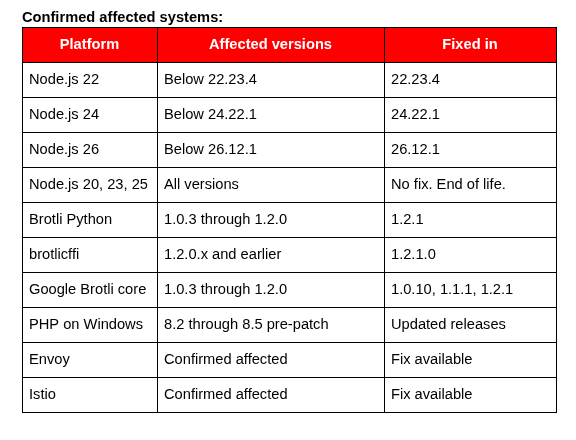
Currently, Go Brotli implementations remain vulnerable, with no fix being released. Each runtime requires an independent patch. Updating Node.js does not cover Python services, PHP processes, or any other runtime on the same infrastructure.
Not sure which services in your stack are exposed? Codilar’s DevOps team can run a full Brotli dependency audit across your eCommerce infrastructure.
The Brotli decoder flaw allows an attacker to corrupt server memory by sending a crafted compressed HTTP payload. In vulnerable configurations, that memory corruption can escalate to remote code execution with full shell access on a production server, requiring no authentication.
The vulnerability has two entry points depending on how your application uses Brotli.
If your application makes outbound HTTP requests, it exposes the client side. Node.js’s built-in fetch() and Python libraries such as urllib3 and requests auto-decode Brotli-compressed responses by default. A malicious server returning a crafted response automatically triggers the vulnerable decoder, with no explicit Brotli usage in your application code.
If your application accepts inbound requests, it is exposed on the server side. Express 5 and body-parser 2 decode request bodies sent with Content-Encoding: br when Brotli parsing is configured. An attacker sends a crafted, compressed request body, triggering the same flaw.
Most production eCommerce stacks have both paths open simultaneously.
CISA’s inclusion of KEV is not precautionary. It reflects confirmed exploitation against live production infrastructure. A 9.2 CVSS score, a public proof of concept, confirmed in-the-wild traffic, and widespread deployment of affected runtimes across the web stack- all conditions were met before the federal deadline was issued.
Headless storefronts, PWA frontends, and Next.js applications do not run in isolation. They run alongside build pipelines, ERP integrations, middleware services, and reverse proxies on shared cloud infrastructure. The Node2Shell vulnerability follows wherever the Brotli decoder has been embedded.
A Next.js frontend, a Node.js middleware layer handling authentication or cart logic, a BFF sitting between the storefront and the commerce platform: each is a direct exposure point through Node.js’s built-in HTTP client and body parser integrations.
Python services carry their own risk through the dependency chain. The Brotli Python vulnerability travels through libraries such as urllib3 and requests. Application code does not need to import Brotli directly to be exposed. A Python-based ERP connector or OMS integration that makes outbound HTTP requests is a potential attack path if the Brotli package has not been updated.
Docker requires specific attention. Patching the host server does not update containers built before the CVE-2026-111497 fix was available. Each container carries its own copy of the Brotli library. Those images must be rebuilt from updated base images and redeployed. Restarting containers does not apply the fix. A fully patched host can still be serving live traffic through dozens of vulnerable containers.
Patching Node2Shell is not a single update. It is an audit across every component in the stack that touches Brotli.
Step 1: Inventory Every Place Brotli Lives in Your Infrastructure
Run dependency scanners across production servers, build environments, Docker images, CI/CD runners, and staging environments. Do not limit this to production, as a compromised CI/CD pipeline can expose deployment credentials and indirectly reach production.
Step 2: Patch Each Component Independently
Update Node.js, PHP, Python packages, .NET, and Bun to their fixed versions. Updating the system-level Brotli package alone does not fix an application that bundles its own copy internally.
Step 3: Rebuild and Redeploy Container Images
Container images carry their own runtime dependencies. Patching the host system does not update containers already built on vulnerable base images. Rebuild from updated base images and redeploy.
Step 4: Restart Affected Processes
A patched binary does not take effect until the process using it restarts. After updating Node.js or PHP runtimes, restart the relevant services.
Step 5: Verify Running Versions
Confirm that the processes now running reflect the patched versions. A deployment error can leave old binaries in place even after an update.
Step 6: Apply WAF Mitigation if Patching Cannot Happen Immediately
Configure your Web Application Firewall or reverse proxy to reject incoming requests carrying Content-Encoding: br. This blocks the attack path for inbound compressed requests. It does not cover outbound Brotli decompression, meaning services that fetch external URLs and decompress the response remain exposed until patched.
Step 7: Check Logs for Signs of Compromise
Because CISA confirmed active exploitation before most teams had patched, any server that was exposed during the window should be checked for signs of compromise. This includes unexpected processes, unusual outbound connections, unexpected file modifications, abnormal crashes, and suspicious access to credentials or customer data.
CVE-2026-111497 is as much a supply chain problem as a vulnerability. Brotli is a transitive dependency in most modern eCommerce stacks, which arrives via Node.js’s bundled runtime, Python package dependencies, container base images, and infrastructure components such as Envoy. Most teams have no direct relationship with the Brotli library and no visibility into where it sits across their infrastructure. Node2Shell exposed the gap
The underlying question is whether your team has full visibility into every runtime and container carrying a Brotli dependency across your production environment. Without that visibility, a patched application server and a vulnerable container can coexist on the same infrastructure undetected.
The November 10 federal deadline is not a guideline. If you do not have confirmed patch status across every service and container in your stack, the window is closing.
Codilar’s DevOps team delivers vulnerability assessments and end-to-end patching support for eCommerce infrastructure. Connect today
Node2Shell is the name for CVE-2026-111497, a critical out-of-bounds write flaw in the Brotli decoder. It allows an attacker to trigger memory corruption through a crafted Brotli-compressed HTTP response and achieve remote code execution on the server. CISA confirmed active exploitation on October 27, 2026.
All three are names for the same vulnerability, CVE-2026-111497. Node2Shell became the dominant name because Node.js was the first confirmed exploitation target. HTTP2Shell and Broccoli2Shell appear in some security advisories and refer to the same flaw.
All versions below 22.23.4, 24.22.1, and 26.12.1 are affected. Node.js 20.x, 23.x, and 25.x are end of life and will not receive a patch. Teams on these versions must migrate to a supported release.
Update Brotli Python to version 1.2.1 and brotlicffi to version 1.2.1.0. Libraries such as urllib3 and requests carry the vulnerability through the dependency chain. Audit the full dependency tree and regenerate lockfiles after updating.
? Configure your reverse proxy to reject requests with Content-Encoding: br. This removes the Brotli decoder from the inbound attack path. Outbound exposure through HTTP clients requires upgrading the affected packages.
Each Docker container bundles its own copy of the Brotli library independently of the host server. Patching the host does not update containers built before the fix was available. Those images must be rebuilt from updated base images and redeployed to fully remediate the vulnerability.

Get tailored technology solutions to scale your retail business online
Request A Quote

Stay ahead with insights, trends, and brand success stories from the world of Digital Commerce.


With the world's leading digital commerce agency.