



General
PHP2Shell: eCommerce Teams Must Patch This Critical PHP Vulnerability
Nikki Kumari|Nov 6, 2026|Read 5 Min




Let me ask you something. When did you last look up a product without asking ChatGPT (or Gemini, or Perplexity) first?
For a lot of your buyers, that's where shopping starts now. Someone types "good standing desk under $600 that ships this week," gets three suggestions, asks a couple of follow-ups, and then clicks through to one store. Just one.
You don't see any of that. If your desk didn't make the top three, that shopper basically ghosted you before you even got to say hi.
That's the whole idea behind agentic commerce. An AI assistant does the looking around (and sometimes the buying) for the shopper. And here's the part that affects you: it can only suggest products it can actually read on your site.
So what should you do about it if you're on Magento or Adobe Commerce? That's what I want to walk you through. We'll go roughly in the order you'll bump into things: why it's worth bothering, what version you're on, what Adobe Commerce already gives you, what you can do on Open Source, and how to make your catalog readable. I'll lean on Adobe's own numbers and docs, plus what we've learned in over 11 years as an Adobe Gold Solution Partner and Magento development company.
Adobe Analytics tracks over a trillion visits to U.S. retail sites. In July 2026, visits coming from AI assistants were up 62% from the year before. Since October 2024, when Adobe started counting, they're up 1,219%. Big numbers, sure. But the stat that lowkey shook me was conversion. Shoppers who came in from an AI tool converted 60% better than everyone else. And no, it's not a fluke. July was the 11th month in a row.
Here's the catch, though. Adobe also checked how much of a typical retail homepage a machine can actually read. The average was 61%. So close to 40% of what's on those homepages is pretty much invisible to an AI.
So yeah, this isn't just your SEO person's problem anymore. Your Magento version, your hosting, how your pages load, how tidy your product data is... all of it now decides whether an assistant recommends you or skips you.
Adobe said much the same thing at its Summit in April 2026. Shoppers start in tools like ChatGPT and Gemini, compare things there, and the quality of your product data shapes what gets recommended.
That leaves you with two questions. Can an AI read your catalog? And, the slightly awkward one, what's your store actually running on?
I know, I know. You want the fun AI stuff. Trust me though, check this first.
Every 2.4.x release gets three years of support from Adobe, counted from the day it's generally available. After that, Adobe Commerce customers can pay for extended support. Open Source users can't. When your version's done, it's done.
Here's how the dates work out under Adobe's lifecycle policy:
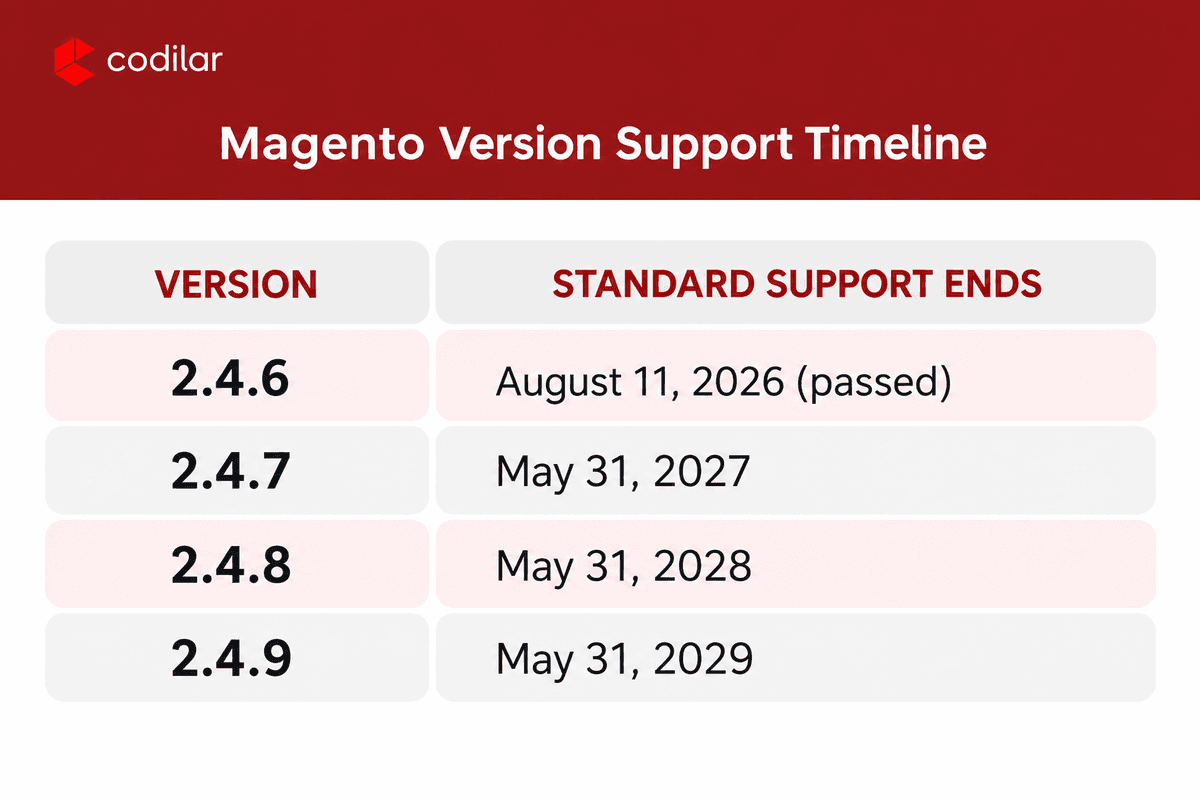
If you're still on 2.4.6, not gonna lie: your store has gone without standard security patches since August. Sort that out before anything else in this post.
And if you're eyeing 2.4.9 (it came out on May 12, 2026), go in with your eyes open. It's not a quick update. It's more like moving house, and nobody's vibing on moving day. Adobe's release notes make PHP 8.5 the production version, keep PHP 8.4 only for the upgrade itself, and drop 8.2 and 8.3. Zend_Cache is out and Symfony Cache is in. Laminas MVC is gone too, swapped for Magento's own MVC layer. And Valkey 9.x and OpenSearch 3.x are supported now. Every one of those is a chance for an extension or a hosting setting to break.
My advice? Do a proper dress rehearsal on staging. Not a quick click around the homepage, but the real stuff: place orders, run your imports, let the ERP sync. Old extensions with outdated Composer requirements can stop the upgrade before Magento even installs, which is why that's the very first thing we check in a Magento upgrade assessment. We've run this staging-first process on some big moves, like a 500,000+ SKU catalog going from Magento 1 to Adobe Commerce with zero data loss, and the 25,000+ product catalog for Homes r Us.
Once your version's in a good place, take a look at what Adobe Commerce already gives you. You might be paying for some of it and not using it.
The one that's ready today is search. Semantic search became generally available in Live Search on June 8, 2026, and there's no extra charge. Instead of hunting for exact keywords, it tries to work out what the person meant. So if someone searches "shoes for trail running," they can still find products you've described as hiking or off-road footwear. Your filters, synonyms and merchandising rules carry on working like before.
There are a couple of limits (Adobe's docs spell them out). It only works on English catalogs. And all you get in the Admin is an on/off toggle, nothing to fine-tune. On Adobe Commerce Cloud or on-premises, you'll find it under Marketing > SEO & Search > Live Search. On Adobe Commerce as a Cloud Service, it's already on for eligible catalogs.
Does it actually help? Adobe says a furniture retailer cut its "no results" searches by 57% in the first month of testing, and a fashion brand cut them by about 30% in ten days. Those came from Adobe's own beta, so maybe don't treat them as gospel. It's easier to note your own no-results rate, flip the switch, and look again in a month.
The agent side is newer. At Summit, Adobe announced a Commerce MCP server. Put simply, it lets your developers plug an AI assistant straight into your catalog, cart, prices, stock, promotions, checkout and orders, in real time. There's also a Brand Concierge integration that adds chat-style shopping to your storefront. And Adobe says it's committed to the UCP and ACP agent protocols and is working toward supporting them. Before you plan anything around these, ask your Adobe contact what's actually live for your setup.
One last thing here. There's an LLM Optimizer integration (Adobe now calls it Brand Visibility) that suggests better product names and descriptions for AI answers. Nothing goes live until you approve it, which is honestly a green flag. Access is limited right now, it works for Cloud and on-premises projects, and it can't do much if AI bots can't crawl your storefront in the first place.
Plenty of stores stick with Open Source, and fair enough. It's cheaper and you're in control. The catch is that the AI pieces don't come in the box. Live Search and Product Recommendations are Adobe Commerce services, so on Open Source you get there with Marketplace extensions or your own code.
There's already a decent amount to pick from. Here are a few I spotted in current listings (not recommendations, just so you know what's out there):
A quick word of caution. Most of these send data off to an outside AI model. So you're paying for the API calls, and if customer data leaves your store, that's on you. Read the fine print on how each one handles data before you install it.
Oh, and a small bonus if you're on 2.4.9: the clearCart GraphQL mutation is now part of Open Source. Doesn't sound like much, but it lowkey slaps if you're building an agent that manages a shopper's cart.
We've been down this road ourselves, actually. At Codilar we built a Magento MCP server that lets AI assistants work with your catalog, orders, inventory and quotes. It hides personal data, and it only gets the permissions your admin roles already allow.
Honestly, whatever version you're on, this is where I'd spend my first week. It's not glamorous, but no cap, it matters more than any protocol.
Back in December 2024, Vercel and MERJ studied real crawler traffic. They found that OpenAI's and Anthropic's crawlers download JavaScript files but don't run them. Gemini's different, because it piggybacks on Googlebot. So if your price or stock status only appears once JavaScript kicks in, some assistants will never see it. Now, that study's almost two years old and crawlers change, so please don't just take my word for it. Test your own pages.
"Most teams want to start with the agent. We ask them to start with the product page. If an assistant can't see your price or stock in the HTML, it doesn't matter how smart the agent on top is. It won't recommend you."
Shahed Jamal, Practice Head, Adobe Commerce, Codilar
It's a five-minute job:
curl -s -A "GPTBot" https://www.yourstore.com/your-product.html | grep -iE "price|instock|outofstock"
Speed counts here too. When we worked with AAW, a Kuwait retail group running six Adobe Commerce stores, category pages were taking up to 10 seconds to load. We added Varnish full-page caching and moved product listing data into Elasticsearch with Powerlisting, our in-house listing tool. Category pages dropped to 1.2 seconds, product pages got up to 70% faster, and checkout now loads in under 2.5 seconds, all without adding a single server. A fast, cached page that arrives with everything already in the HTML is good for shoppers, and it's exactly what a crawler wants too.
Once that's fixed, here's a simple 30-day plan I'd suggest:
Here's a five-minute test, and it's free (we love that). Open ChatGPT, Gemini or Perplexity and ask about your best-selling product. What price does it give? Does it know if it's in stock? Does it even mention your store?
If the answer's no, or it gets things wrong, you've found your starting point. And if you'd like a hand, our team does a free Magento version and health audit. We'll look at your version, your stack and how ready you are for AI shoppers, and tell you plainly what we find.
Basically, it's when an AI assistant does the shopping legwork for someone. It searches, compares, and sometimes buys. There are protocols that set how these agents talk to online stores: UCP is Google's, and ACP comes from OpenAI and Stripe.
Not under standard support. That ended on August 11, 2026. If you're on Adobe Commerce, you can pay for extended support until August 31, 2027. Open Source has no extended option, so it's time to plan your move to 2.4.9.
It does. Adobe announced it for developers at Summit 2026. What you can use depends on your edition and hosting, so check with your Adobe team. If you're on Open Source, third-party MCP extensions can do a similar job.
Not reliably. In the Vercel and MERJ study, OpenAI's and Anthropic's crawlers didn't run JavaScript at all. Your safest bet is to put price, stock and product name straight into the HTML, then check the page source yourself.
Nope. Semantic search and the LLM Optimizer integration are Adobe Commerce features, but Open Source stores can add plenty through extensions and custom builds. If you're on the fence about the license, our Adobe Commerce platform fit assessment compares the total cost of both.

Get tailored technology solutions to scale your retail business online
Request A Quote

Stay ahead with insights, trends, and brand success stories from the world of Digital Commerce.


With the world's leading digital commerce agency.