



Shopify
Shopify GraphQL Admin API Migration Guide for Custom Apps and Integrations
Anusree V Anand|Nov 16, 2026|Read 8 Min




A US retailer has approved your line on one condition: all order, shipment, and billing documents must be exchanged through EDI. A Shopify Plus store can manage this with an additional connecting layer. This layer connects Shopify and the retailer, converting documents into formats both systems can understand and exchange.
This article covers how a Shopify Plus EDI integration connects your store with retailers and distributors. It explains how that layer handles the purchase order, the advance ship notice (ASN), and the invoice. It also explains Shopify Plus’s built-in B2B features, integration models, and compliance gaps that can lead to chargebacks.
Most US retailers and distributors use ANSI X12 to read each other’s documents. Each retailer has its own implementation guide, so a national chain may require different segments for the same document than a regional distributor.
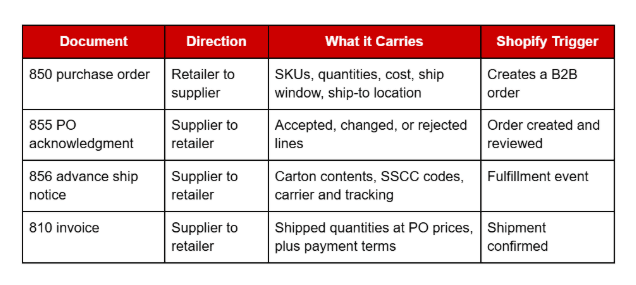
Apart from the main documents, there are other documents, including 997, 860, and 846, that help manage communication between suppliers and retailers. This helps keep orders accurate, track changes, and share updated inventory information.
Shopify doesn’t have a built-in EDI system on any plan to receive, translate, or send X12 files. The platform manages and stores order, inventory, customer, and fulfillment records. An additional integration layer establishes a connection between Shopify and the retailer. For the Plus store, the process is called Shopify Plus EDI integration. It accesses Shopify’s information through the Admin API and webhooks, converts it into the required EDI format, and exchanges the documents between both systems.
Businesses can leverage Shopify’s B2B data model, available across all plans. The features include:
Companies and company locations
Businesses set up and manage wholesale customers and their business locations.
Quantity rules
Facilitate customization of product quantity for purchases.
Catalogs
Support up to three active B2B catalogs on non-Plus plans, and it is unlimited on Shopify Plus. It enables product selection and pricing for B2B customers.
PO numbers
Supports purchase order numbers when placing and managing B2B orders.
Net payment terms
Payment is due within the agreed period, such as Net 30 or Net 60.
For B2B, Shopify Plus offers features that aren’t available on other Shopify plans. Explore a detailed breakdown in this guide to Shopify B2B commerce features and limits. Below are some B2B features and their capabilities:
Shopify B2B and retail EDI are separate ordering routes that can be run simultaneously. Shopify B2B allows wholesale buyers to log in and place orders, and Retail EDI communicates between the systems without visiting the store.
Shopify’s native B2B features don’t support EDI. Translation and connectivity, retailer-specific mapping, and carton labels need additional layers such as an EDI provider, middleware, an app, or custom development.
An EDI provider or middleware can convert incoming ANSI X12 files into Shopify orders and Shopify data into the required ANSI X12 format. It can handle communication with retailers through AS2, a VAN (Value-Added Network), or SFTP. Also, it can check the requirements for product codes, pricing, shipping details, and document formats before sending. A warehouse management system (WMS), third-party logistics provider (3PL), EDI provider, or third-party app generates GS1-128 carton labels containing unique SSCC codes, which helps retailers match physical cartons with the information in the ASN.
A Shopify Plus EDI integration treats each retail PO as a normal Shopify B2B order with extra rules. The flow has eight steps:
Step 1: The PO is sent through AS2, VAN, or SFTP. A 997 is returned after parsing and validating the PO.
Step 2: EDI integrations match the different product codes and location identifiers to help Shopify understand exactly what the retailer has ordered.
Step 3: The validated PO is created as a Shopify B2B order, which commits the ordered stock so it can’t be sold through other channels.
Step 4: POs that fail validation are kept in a review queue to check the issue and correct it before the order moves forward.
Step 5: The retailer receives an 855 that tells them what will be delivered and what's short.
Step 6: The warehouse team or 3PL labels each carton with a GS1-128 label carrying a unique SSCC to track the shipment for the retailers.
Step 7: The supplier sends an 856 to inform retailers about the product shipment and products in the packaging.
Step 8: Suppliers send an 810 for the products actually shipped and record the transaction in their accounting system.
The right Shopify Plus EDI integration depends on the number of trading partners, inventory management, and control over integration. Businesses generally choose one of four models for Shopify Plus integrations with EDI.
An EDI provider's Shopify App
This ready-made app is a quick and easy option to meet basic EDI requirements, but it has limitations for complex operations.
ERP-centric EDI
Handles most of the order and EDI operations, but Shopify may see order and inventory updates with a delay, depending on sync frequency.
A full-service EDI provider
Supports most of the EDI work, but it has less direct control and may face higher costs.
Custom middleware with an EDI translator
The most flexible option, built around the business’s specific requirements. It requires more investment and ongoing technical support.
An EDI integration model chosen after considering how orders, inventory, pricing, and fulfillment information will transfer between all the business systems. Also decide which system is the main source of inventory information.
US retailers enforce chargebacks on suppliers, deductions taken from your payments when a shipment or document breaks the rules. Most chargebacks come from four causes, and those can be controlled.
1. Invoice disputes
This occurs when there is a mismatch between the supplier’s invoice and the purchase order and shipment details. The retailer may dispute it or deduct the difference.
2. Ship window violations
A chargeback is enforced when the shipment is sent too early or delivered too late.
3. ASN mismatches
This occurs when the SSCC code on a GS1-128 shipping label has a mismatch with the 856 ASN. Missing labels, incorrect carton quantities, or sending the ASN late can also contribute.
4. Double-promised inventory
A retail PO that never becomes a Shopify order holds no stock, so your online store can sell the same units. This leads to short shipments against the PO, which retailers penalize through fill-rate chargebacks. Shopify’s Help Centre notes that the draft order reservation can temporarily hold stock for a specific period. This reservation expires, so converting every accepted retail purchase order into a proper Shopify order is still required.
Generate the ASN using actual carton-level information to ensure the SSCC codes and product quantities match the physical cartons. This can prevent ASN mismatches, one of the most common causes of chargebacks.
Setting up retail EDI can be challenging, and a small mistake can create problems. Common mistakes include inconsistency between retailer product codes and Shopify products, which results in shipping the wrong products. ASNs generated without cross-verifying actual carton content may cause incorrect information about the shipment for the retailers. A mismatch between the PO and invoice can result in delayed payment or penalties.
Shopify Plus EDI integration comes down to two early decisions that include which system owns inventory for accurate inventory information and how issues such as incorrect product codes, pricing differences, or unavailable stock will be identified and resolved.
Codilar can help with Shopify Plus integration across ERP, 3PL, and trading partner systems. Also, we provide product and location mapping, middleware, and integrations required to connect these systems. Contact Codilar to discuss what your Shopify setup needs.
No, Shopify has no built-in EDI, and it cannot receive, translate, or send EDI documents directly. An additional layer such as an EDI provider, a connector app, or custom middleware is required to set up a Shopify EDI integration, translate X12 documents, and pass the data to Shopify through its APIs.
Since April 2, 2026, B2B operations run on all Shopify plans at different levels. Basic B2B requirements and up to three active B2B catalogs are available with non-Plus plans, whereas Plus offers unlimited catalogs, direct catalog assignment to companies and company locations, deposits, and partial payments.
EDI has not been fully replaced, but APIs are widely used to exchange information in real time. Many US retailers and distributors still require EDI files for POs, ASNs, and invoices.
The timeline depends on the documents involved, the number of retailers, and the complexity. The process is faster when a connector already has pre-built maps. Businesses that need custom development, retailer-specific document mapping, and certification testing should plan for about 2–8 weeks of testing and certification per partner.
Yes, Shopify can support many B2B businesses with features such as company accounts, catalogs, quantity rules, and net payment terms for all plans. Businesses with complex requirements use Shopify Plus.

Get tailored technology solutions to scale your retail business online
Request A Quote

Stay ahead with insights, trends, and brand success stories from the world of Digital Commerce.


With the world's leading digital commerce agency.