

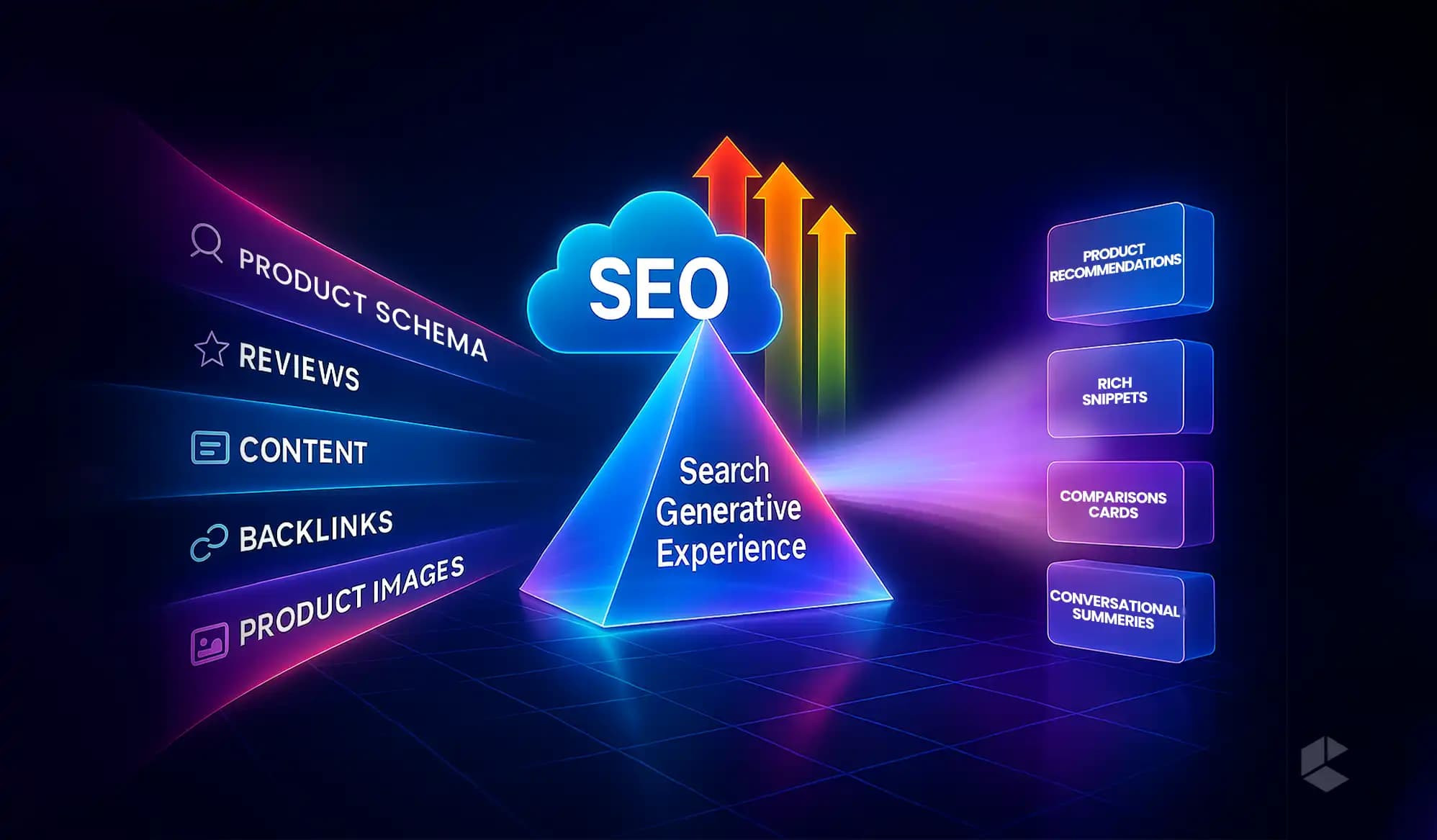
- AI search reshapes eCommerce discovery behavior
- Top funnel traffic declines noticeably
- Mid-funnel keywords gain strategic importance
- Structured data strongly supports AI visibility
- Comparison content improves decision-based rankings
- Expertise signals boost trust in AI engines
AI search is not some future thing that might disrupt eCommerce “one day”. It is already here, quietly eating into classic organic traffic and rewriting how people discover, compare, and buy products.
For eCommerce brands, that means one uncomfortable truth: ranking on page one of Google is no longer enough. If you are not present in AI Overviews, chat-style engines, and other AI-powered surfaces, you are simply missing from a big chunk of the decision journey.
This article breaks down how Search Generative Experience (SGE) and other AI search engines are changing eCommerce SEO in practice, and what you can do about it using strategies that are already tested in real projects.
Why AI Search Matters for Ecommerce SEO
Search behavior has become more fragmented and complex. People no longer use only the traditional search box. They ask AI tools questions directly, and they treat AI responses as an alternative search engine.
Recent research shows that:
- Around 71% of people already use AI tools for search.
- 14% use these tools daily.
- Over 20% have switched their primary search platform within the last year.
If an eCommerce brand is not showing up in AI search results, it is simply absent from a large and fast-growing part of the funnel where real purchase decisions are made.
There is also a marketing gap. Only about 19% of marketers are currently planning a specific SEO strategy for generative AI search. Therefore, the brands that move early gain a genuine competitive edge, while others remain stuck in traditional SERP thinking.
The shift is not identical across ages. Adoption varies by generation:
- Baby Boomers mostly stick to traditional search, but many have at least tried AI.
- Gen X uses AI search occasionally yet still defaults to Google.
- Millennials split their usage between AI and traditional engines.
- Gen Z uses AI search very actively and relies heavily on social media for product discovery.
The lesson for eCommerce is simple. There is no single channel that covers everyone anymore. You need a mix of traditional SEO, AI search visibility, and, in many cases, social discovery, if you want full funnel coverage.
How SGE Is Changing ECommerce Search Visibility
For eCommerce businesses, the impact of SGE and other AI search experiences is already visible in the numbers and in how users behave.
Reports in some verticals show traffic drops of up to 30% as AI results and “brave new search” layouts pull clicks away from classic organic listings. At the same time, brands that adapt quickly are seeing new traffic and sales from these very same AI-driven channels, so it is not all a loss.
Adobe Analytics data highlights how brutal this shift can be:
- Generative AI referrals to retail sites jumped by 1300% during the 2024 holiday season compared to the year before.
- By February 2025, generative AI traffic to retail was still up around 1200% compared to July 2024.
- Travel saw a spike of about 1700%.
- Banking traffic from AI also grew by roughly 1200%.
In other words, AI search is not a tiny experimental sidebar anymore. It is a serious acquisition channel that grows incredibly fast.
But the changes go deeper than click numbers.
Conversational Queries Instead of Short Keywords
Users are moving from short keyword phrases to natural language questions.
Instead of typing “Buy running shoes,” they now ask things like “What are the best running shoes for flat feet under 200 dollars?”
Those longer, more detailed prompts change which pages appear in AI Overviews and what tools like ChatGPT or Perplexity choose as sources. Generic product listings built around short SEO phrases are far less likely to be used than content that directly answers those conversational queries.
More Zero-Click Decisions
Zero-click search is not new, but AI has amplified it. Many users now get a complete answer from an AI Overview or chat window and never proceed to a website.
Think of someone choosing between two consumer cameras, like the Canon G7X Mark II and the Sony ZV 1. They may not want to read deep technical reviews. A brief AI summary with pros and cons might feel enough to make a decision. That obviously means fewer clicks to detailed pages for that kind of query.
However, this pattern is not universal. In more complex or high-ticket categories, people still click through to compare specifics, read lengthy reviews, or check specifications. Each eCommerce business has to understand its own category and figure out where AI replaces clicks and where AI actually pushes more qualified visitors to product pages.
The New Challenges for ECommerce SEO in an AI World
AI search does not kill all traffic. It reshapes which parts of the funnel are vulnerable and where competition intensifies. Three big shifts stand out.
Top of Funnel Content Is Losing Visibility
Informational queries, especially broad “best of” and “how to” searches, are now heavily covered by AI answers. Examples include:
- “Best running shoes 2025”
- “How to clean leather boots”
These are exactly the types of queries where eCommerce blogs and guides used to gain a lot of top-of-funnel traffic. Now, AI systems often deliver a full answer that removes the need to visit multiple sites. That means shrinking organic sessions for TOFU content in many verticals.
Transactional Queries Are Less Affected (For Now)
Direct purchase queries, such as “Buy Nike Air Max size 42,” are still less affected by AI. Engines often see clear buying intent and simply route users straight to product pages or shopping units.
So far, transactional SEO remains relatively stable. But that is also where competition is heating up, because more eCommerce brands are fighting for the same high-intent queries while TOFU becomes less reliable.
New Competition Inside AI Overviews
Even when clicks still happen, there is now an extra layer of competition: the AI Overview box or equivalent AI answer.
Being mentioned there already builds trust and brand recall, even if the user does not click your link. If your competitors are cited and you are not, they win the perception battle before the click ever happens.
Why Getting into AI Answers Is Worth the Pain
Optimizing for SGE and AI search is not only about protecting your existing traffic. It also unlocks advantages that traditional SERP listings never had.
Being Cited Builds Authority
When your store or brand is named inside an AI summary, you are framed as a trusted reference.
For example, if an AI Overview compares two popular sneaker models and cites the official store of one brand as a source, that mention alone influences buyer perception. Even without a click, the brand gains authority in the customer’s mind.
Over time, repeated mentions work like a branding campaign hidden inside search.
AI Favors Real Expertise
AI engines are currently flooded with shallow, machine-written content. That is exactly why they are keen to find sources that demonstrate real expertise.
Brands that publish content with genuine know-how, clear explanations, and unique insight have a much stronger chance of being used in AI answers than sites that only throw together generic product descriptions and thin listicles.
Transactional SEO Can Become Easier
AI often handles the research and decision support part of the journey, then directs users straight to places where they can buy. For well-optimized eCommerce sites, this means that transactional SEO can actually get more efficient.
The task becomes clear. You have to teach AI engines that your products are the right destination once the user is ready to act.
How To Adapt ECommerce SEO For AI Search Engines
Now to the practical part. What exactly should eCommerce brands do to keep up with SGE and AI search engines in general? The reference framework suggests several key moves that have already shown results.
1. Shift Focus to Mid and Bottom Funnel Keywords
Since informational traffic is shrinking, eCommerce SEO for AI needs to prioritize mid-funnel and bottom-funnel queries that connect directly to purchase decisions.
Top of funnel topics like “how to style summer outfits” can still support brand awareness, but they rarely convert in AI-driven environments.
Instead, keyword research should dig into searches such as:
- “women’s linen blazer under 150”
- “best carry-on suitcase with spinner wheels”
These phrases already contain clear buying intent. AI engines are more likely to surface direct product recommendations for them, and that is where you want your catalog to appear.
One extra complication. For purely informational queries, tools like ChatGPT often rely on their internal memory and training data rather than on links. That means trying to “rank” for many of those questions is simply not realistic anymore. Which again pushes eCommerce brands toward intent-heavy keywords.
Add Comparison and Decision Support Content
AI search engines love content that makes decisions easier for users who are close to buying.
So, it helps to build:
- “X vs Y” product comparison pages.
- “Best under $X” curation lists.
- Feature comparison tables that highlight what buyers truly care about.
AI systems frequently pull from these structured, side-by-side resources because they align perfectly with what a user is trying to decide.
2. Build Serious Topical Authority
Topical authority is still a core SEO concept, but in AI-driven eCommerce search, it becomes even more important.
Cover Your Category Deeply
The starting point is a clear content architecture that mirrors real user questions across the buying journey. That often means:
- Exporting long tail keywords with modifiers like “best”, “vs”, “for [need]”, and “under $X”.
- Grouping them into clusters that represent different stages: research, comparison, and purchase.
Take skincare as an example. Instead of a single generic article about moisturizers, a brand can create a hub page that links to focused guides, such as:
- Moisturizers for oily skin.
- Moisturizers for sensitive skin.
- Moisturizers with retinol.
- Moisturizers with hyaluronic acid.
- Moisturizers under a specific price point.
Each subpage answers a specific query, then connects back to the central hub. Skincare brands that follow this kind of structure are already gaining visibility inside AI-driven answers because engines see them as clear authorities on the topic.
Use Expert and Customer Voices
Publishing more pages is not enough. AI systems look for signs that a brand is backed by real expertise and trusted users.
Practical ways to send those signals include:
- Adding commentary from specialists such as dermatologists, fitness trainers, or tech experts.
- Highlighting verified customer reviews.
- Encouraging user-generated content, including photos and unboxing videos.
These elements strengthen the same E-E-A-T style signals that matter in classic SEO. When AI tools decide between two similar pages, the one with authentic expert and customer input usually wins.
3. Optimize Content So AI Can Use It Easily
AI engines read content in chunks, or more precisely, in token windows. They need compact, self-contained pieces of information they can lift into answers.
A practical pattern for eCommerce pages is:
- Add a short summary right under the H1, around 40 to 60 words, that explains the core point without fluff.
- Use clear H2 and H3 headings aligned with user questions and pain points.
- Structure the page as problem-solution content wherever possible.
Bullet lists and numbered steps now work almost like pre-built AI snippets. Engines can copy them directly into AI Overviews or chat responses.
It is also useful to add a short FAQ section at the end of key pages, based on real queries you find in Search Console or question tools. That gives you more angles to match the natural language that people type or speak into AI tools.
Built this way, content becomes easier for both humans and machines:
- Users can scan and get answers quickly.
- AI engines can confidently interpret and reuse your explanations.
4. Leverage Structured Data as a Core SEO Asset
Structured data is one of the strongest levers eCommerce brands have for AI visibility. It essentially labels the pieces of your page, so AI systems do not have to guess what each element represents.
For eCommerce sites, the baseline usually includes:
- Product schema with name, description, brand, SKU, and GTIN.
- Offer schema for price, currency, availability, and shipping options.
- Review and AggregateRating schema so AI can surface ratings and social proof inside overviews or carousels.
- FAQ schema for pages that answer real buyer questions.
- HowTo schema for step-based guides such as cleaning, care, or setup instructions.
It is not enough to generate this once with a plugin and forget it. The markup has to be:
- Validated with testing tools.
- Checked in Search Console under Enhancements.
If the schema contains errors, engines may ignore it altogether.
You also need to keep structured data up to date. AI engines pull this information in real time. If your schema says a product is in stock, but it is actually sold out, that inconsistency hurts trust and can damage visibility in AI answers.
Many brands solve this by synchronizing schema with their CMS, product feeds, or Google Merchant Center via automated updates or API connections. The main idea is to treat structured data as a living system, not a one-time setup.
5. Monitor AI Visibility and Experiment Early
You cannot improve what you do not measure. AI visibility does not live in a single dashboard, so you have to combine several data sources.
Useful tracking angles include:
- AI Overview tracking to see which queries trigger AI Overviews, which domains get cited, and how often results rotate.
- Generative engine monitoring for mentions and links in ChatGPT, Perplexity, Gemini, and similar tools.
- Classic SERP feature tracking because many AI answers reuse the same pool of featured snippets, People Also Ask entries, and FAQ results.
- Brand and product monitoring across media, forums, and social networks, since external mentions help AI engines connect entity signals.
- Log files and analytics to identify crawl patterns from AI bots and unusual referrers from generative tools.
On top of that, brands can build a simple KPI board that tracks:
- The percentage of target queries where the brand appears in AI Overviews.
- Monthly mentions in major AI engines.
- Visibility versus click-through in AI-related snippets.
- How quickly the site loses and regains citations in these answers.
Test New Formats and Channels
AI engines are becoming multimodal, which means they pay attention to more than just text. To keep an edge, eCommerce brands should experiment with:
- Original product images, demo clips, and short videos that add context.
- User-generated photos and social proof that show the product in real life.
- Regional landing pages so AI can serve location-appropriate answers.
- Clean and accurate product feeds for shopping surfaces in both Google and Microsoft ecosystems, and new merchant feed options in AI tools as they roll out.
Brands that track carefully and test new formats early tend to secure strong positions that slower competitors struggle to dislodge later.
Conclusion
AI search has quietly rewritten how shoppers discover and compare products, and eCommerce brands can’t afford to treat it as an optional experiment anymore. The real win now comes from building content that helps AI understand your products clearly, structuring pages so machines can use them instantly, and keeping your data clean enough for engines to trust.
When your site consistently shows up where customers make decisions, AI stops feeling like competition and starts operating as an extra sales channel that works alongside your traditional SEO rather than replacing it.